Teaching, Teachings and the Art of Becoming

I think it is far too easy to become a yoga teacher these days. With the operative word being become. Teaching, to me at least, seems to be an art of becoming. One in which you are devoted to the interplay between teaching the teachings and the teachings teaching you. It is a tango between exploration and delivery—a dance that costs more than a couple grand and two hundred hours of your time.

This is not to say the two hundred or more hours of grueling work one undertakes in a teacher training is worthless and for not. It is a perfect place to start. It is a useful launching pad. We must begin somewhere. Somewhere is better than nowhere. Somewhere marks the map of our becoming. Still, two hundred hours of study does not make one a teacher of yoga. It makes one a student of teaching yoga.

Teaching is not only a set of observation and articulation skills. It is not only the theoretical and conceptual knowledge. It is also a certain presence of having walked that knowledge. It is the presence of having tested the articulation and observation. It is the embodiment of the concept one is trying to convey. If the first form of learning is imitation, then as Rudolph Steiner said: “we must be worthy of imitation”. It is our presence, our own embodiment, that is the teaching itself. So two hundred hours of study is the beginning, not the end of one’s becoming a yoga teacher.

Perhaps we should worry less about becoming yoga teachers and concern ourselves more with becoming yogic teachings.

Come to think of it, I cannot even believe the audacity I had at twenty years old to teach a yoga class to a room full of people. It wasn’t like the class was a couple people in my back yard. It was like forty in a university gym. I had not even gone through a formal teacher training yet. To my own credit I had been practicing for four years before I dared to open my mouth to articulate a practice. And you only have to practice for two or sometimes one year before entering some teacher trainings.

I used to egregiously pride myself on this. As if I was some yoga-teaching prodigy. Waltzing in like a know-it-all. As if I was the hot ticket to hanumanasana and enlightenment in seventy-five minutes all under the age of twenty-three. Frankly I think that is some version of crazy. It is a miracle I did not hurt more people along the way.

We are a culture that prizes the archetype of the young prodigy over the wise crone. We are a society of do-more and be-more as quickly as possible. I certainly benefited from this leaning early on. But I’ll be honest with you the road has dead-ended. Do not pass go. Do not collect two hundred dollars. There is no get out of jail free card in the deck. Some people might call this Saturn Return. I call it “Quite wining, grow the fuck up, and be grateful for Life.” Rather than shove the process of yoga into the chaos of grow up and get rich, maybe we could still ourselves long enough to notice the process of becoming that is unfolding within us. That is witness consciousness. That is stillness in motion. 

A good friend once told me "you have to go through every age. If you skip one, eventually you go back." Well I can assure you this comment is accurate. I skipped right on through my adolescence into premature adulthood. And I went back. I went back hard. I am only now, in the past two years emerging from the fog of my adolescent repair. I consider myself lucky. There are others, much older than myself still trying to heal that cycle of life.  I also tucked away my creative young child nature in favor of the wise observant elder. Though I hope to retain my “Old Soul” spirit, the young She is reemerging stronger every day. Thank God.

Back to the yoga scene, I was handed things on a silver platter when I first started teaching yoga. Albeit grateful, I took advantage. I didn’t have to build a following from the ground up when I first started teaching. But I have had to go back to the beginning three times. I cannot waltz onto the scene as the next hot ticket. I have to earn the trust and respect of everyone I come in contact with. Frankly, the only way that seems possible is through the honest and earnest practice for practice. Practice for becoming the teaching I am practicing.

You can’t just skip the stage of the grunt work my fledgling teacher friends. Just so you know. Enjoy it while it lasts. The hard work is coming. The art of becoming is not glorious. Its not really one to follow on twitter or trend on Facebook. The art of becoming someone, that someone being yourself and having the chutzpah to sit that self down as Teacher is some serious business.

The yogis call it krama and deeksha. The shrinks call it human development. The yogis call it svadhaya. The shrinks call it self-knowing. These processes are all dependent on time. Time for digestion and integration.

~

Anyone can imitate. As noted earlier, it is the first step in learning. We are designed to do it. Though to make the leap from imitation and emulation to authentic delivery is a hard won process, not a flash in the pan success. What moves us out of the land of imitation and into the wellspring of authenticity? Time, practice, love, life, falling, recognizing success and practicing some more.

I pride myself now on the teachings I have earned and not so much the ones I have learned. I have learned many teachings from various traditions. Consuming knowledge is not lacking. I could probably regurgitate a ton of “stuff” if you asked.

Trust me, the ways in which I have become the information, digested, integrated, chosen to embody and articulate the teachings; is far more interesting and worthy of your attention.

There is a saying quite popular now; “Be the teachings”. From what I can tell, this is the simplest and most profound way to teach—being the teaching you are trying to teach.

I can help you. I can show you what you see. I can stand in the fire with you. But I must be worthy of your imitation. So that’s what I am working on.
Livia ShapiroComment
I Once Was a Figure Skater

I was a figure skater before I was a yogi.

I know.

I’ll pause for your reaction.


I was a figure skater before I was a yogi. In fact it was the competitive figure skating that took me to yoga. I was sixteen and skating regularly, and I began searching for its compliment. Some kind of cross-training if you will. I wanted to try something new, where I could be kind of anonymous but do a form of movement that would assist my skating. So I ended up in Iyengar Yoga. And so the story unfolds.

My private sessions with my figure skating coach often involved ten to twenty minutes of me talking about what was going on in my life and about ten or fifteen minutes of fierce maneuvering across the ice. We always started our time together with a “check-in”. It just so happened that since I thought my life kind of sucked, and I trusted her, I had quite a load to “check-in” about.

I was once asked to describe something from my past that had surely brought me to my current point on my path. These skating privates were my first experience with what I know now as Somatic Therapy. Now of course this was not Psychotherapy in the traditional sense. We weren’t in an office. I didn’t sign any confidentially agreement. It actually wasn’t the relationship we originally agreed upon. Other friends had purely teacher student relationships with their coaches. But some of us, myself included, also found solace in the intimacy of the teacher-student dyad.

So while it wasn’t psychotherapy, it was therapeutic in that the relationship was healing. She gave me a place to be heard. She gave me a place to tell the truth. She gave me a space to be validated and reminded that my experience was real. When you skate and you hurl yourself at high speeds across frozen icy surfaces and then you fall, you can’t say, “oh that didn’t hurt at all”. That is a lie. It hurts. It hurts a lot. But you get up and you keep going. You learn pretty quickly that your reality of the ice being cold and the falls hurting is true and real. And that you also have to get up, keep going, and where gloves. You also learn that you cannot see yourself clearly. You need someone to sometimes tell you why you keep falling.

It was the first time I understood that in order to process my emotions; I had to move my body. Everything I felt or had talked about in the first part of our lesson I left on the side, and poured myself whole-heart onto the ice. Sometimes I would empty my emotions into my jumps and spins. If I was angry I could leave that mark through my toe-pick. Sometimes I skated to sail away from problems. Sometimes I skated to remind myself of my sanity. But mostly skating just felt good. It felt like I could be home in my body for a little while. I bet the falling and shocking my body into feeling something, albeit pain, was also one of the allures. But that story is for later.

We are very emotionally sterile in our culture. Therapy goes over here, friendships go over there, and education goes in that corner, mentoring in the box over there. To maintain the sanctity, and specialty of the psychotherapeutic relationship is to everyone’s benefit. But sometimes healing does not actually work like that. Again and again we see that the therapeutic relationship itself is what creates healing not just the behavior modifications. In fact, I would argue that behavior modification does not work without a solid foundation in the relational dyad. We also know that moving our bodies in some kind of discipline (Even free form dance has a certain discipline) is regulatory. As my philosophy teacher says, “clear boundaries, no limits.”

So while I honor and abide by the notion that Psychotherapy is a special relationship with very clear documentation, language, structure and limits, we also need to remember that life is circuitous and strange. No relationship fits into a tidy box actually. Therapy and Healing are not isolated events occurring in a vacuum. We reveal our secrets to those we trust. We repair wounds when trust affords safety and offers love. 

Livia ShapiroComment
SEQUENCE: a flow and some pigeons. the mundane and emergent mystical

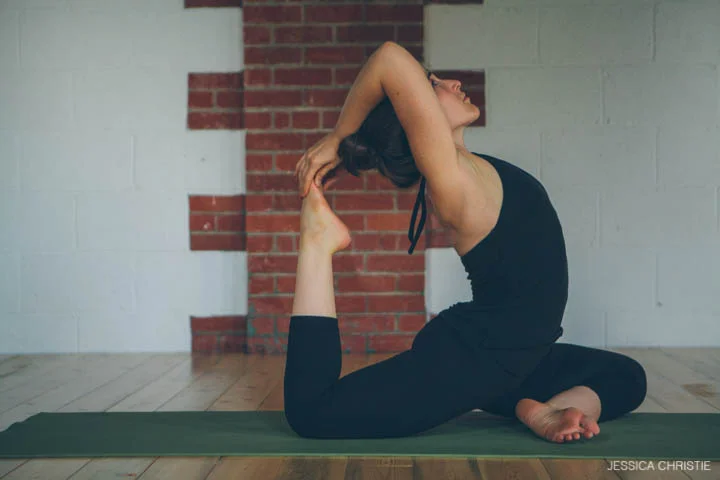
Context: This sequence came out when in was practicing for a while before officiating a best friends wedding. I didn't go into practice with a total plan other than to open myself fully and feel good and (I will use a word I hate when people use to describe yoga) juicy. I wanted something steady, something moving, something hips, something back bending. For me, Urdvha Dhanurasana is a certain kind of backbend that has its own imprint and template with variants off of it. Eka Pada Raja Kapotasana and its variants have a slightly different (of course there are similarities) template for me. So in this practice I actually bypassed Urdvha Dhanurasana).

I think there are times when asana as nonverbal expressive and experiential movement is far more useful than having a plan and efforting to get the peak pose. I find when I go after the Energy and the Feeling I am seeking to cultivate internally, the pose that imprints and expresses that reveals itself to me. In this case, I hadn't done Natarajasana in months and I actually got into it pretty nicely. You will see where in the backbends it could fit if you so choose to go there. And if you know me. You know I love plans. I love the verbal. I love the concrete. So I went ahead and concretized the mystical and the mundane. 

Influences for this sequence:

Christina Sell, Ruthie Fraser, Lara Brunn


CONTENT:


Balasana

Adho Mukha Svanasana

Frog dog

Uttanasana


Surya Namaskar x5 (Frog Dog on the 5th one)

Balasana with twist

Uttanasna (at the back of the mat)

Warrior Lunge Sequence


Crescent

Standing back bend

Forward bend super tight in with arms wrapped around

Utkatasana

Garudasana


Shoulder/arm work against the wall

Crescent against the wall


Trikonasna

Uttitha Parsva Konasana

Vira 1

Vira 2

Parsvotanasana


Lunge arms down inside your front leg/twisted thigh stretch/runners stretch/scandasana

Modified parvritta parsvakonasana twist (knee down)/parsvotanasana


If you want an inversion, I would insert a Pincha here


Ghomukasana

Virasana

Baddhakonasana

Uppa vista Konasana

Janu Sirsasana


Anjaneyasana w/ Marichyasana entry and hands interlaced behind for upper back work

Anjaneyasana w/ Marichyasana entry hands grabbing mat for upper back work)

Parvritta Janu Sirsasana

Hanumanasana

Eka Pada Raja Kapotasana prep working shoulder and arm

Eka Pada Raja Kapotasana x2

(if you have other variants of the pose in you go for it!)


Uttanasana

Parsvotansana

Supta Padangustasana Series

Savasana

Livia ShapiroComment